TL;DR

Get pool and patio gear delivered free — and shop member deals
- Fast, free delivery on millions of items
- Access to Prime Big Deal Days deals on October 6–7
- Prime Video, Amazon Music and more included
A Gardening Know How report points to Dakota Johnson’s Los Angeles garden, shown in an Architectural Digest Open Door video, as an example of how repeated terracotta pots can create a cohesive outdoor display. The report describes a row of roughly 20 or 30 planters along a curved retaining wall and offers practical advice on scale, plant choice and frost protection.
A Gardening Know How report has highlighted the repeated terracotta planters in Dakota Johnson’s Los Angeles garden, shown in an Architectural Digest Open Door video, as an example of a cohesive container display. The report describes roughly 20 or 30 pots arranged along a curved retaining wall at the home, using similar shapes, sizes and material instead of a mix of contrasting containers.
The garden’s row of pots follows the curve of a retaining wall at Johnson’s property. The Gardening Know How report says the property was originally designed in 1947 by Carl Mason. It characterizes the planters as unglazed terracotta, largely similar in size and shape, and says the planting includes repeated shrubs such as roses and azaleas. The source gives an approximate count rather than an exact inventory, so the number of containers and plant varieties should be treated as estimates from the report.
The report’s central design point is repetition: using the same material and a limited range of container sizes can make a group read as one arrangement. It contrasts that approach with mixing pot colors, shapes and heights. The report argues that a repeated line can feel calm and unified, while each pot still develops its own appearance as the terracotta ages and takes on patina. That is the publication’s design assessment, not a measured finding about how viewers respond.
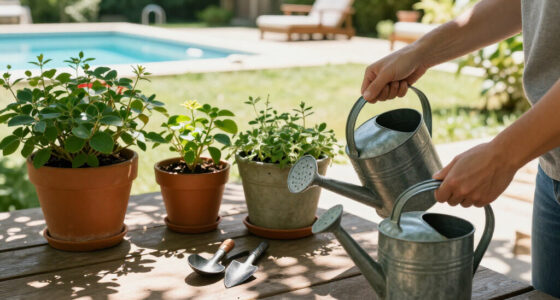
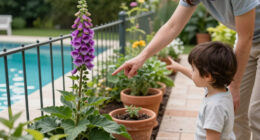
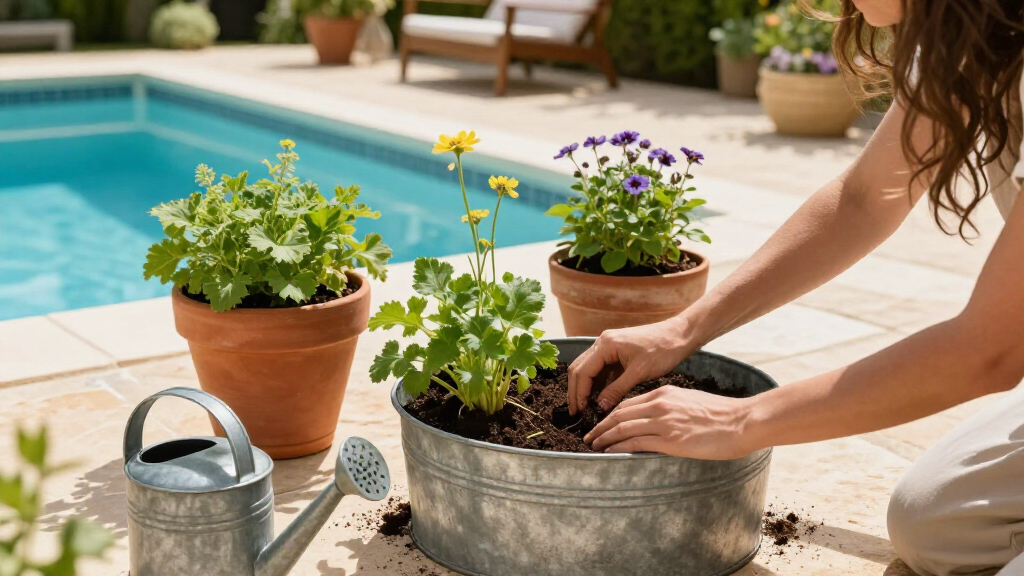
For patios and poolside areas, the article recommends choosing containers with enough scale for the surrounding hard surface. It offers 12 inches in diameter as a minimum rule of thumb for such arrangements, while allowing for larger pots where space permits. The report also suggests repeating similar plants, with heat- and drought-tolerant options such as agave, aeonium, jade and trailing rosemary for sunny locations. For shade, it names ferns, hostas and clipped box balls as possibilities.
How Repeated Pots Shape a Patio
The example gives readers a straightforward design choice to apply to an outdoor area: make the containers work together through repetition, rather than asking every pot to stand out on its own. On a large patio or beside a pool, a series of pots that share a material and scale can visually connect a wall or edge with the planting. That may be useful for homeowners who want a more settled arrangement without coordinating many different colors and shapes.
The approach also shifts attention from the individual container to the line as a whole. Matching pots do not require identical plants in every detail, but the report favors repeating a small group of similar plants to maintain cohesion. For readers, the practical takeaway is to plan for the full space: consider the length of the wall, the diameter of the containers and the mature size and light needs of the plants before buying a row of pots. The cited display is an example, not proof that one style suits every garden.
There are tradeoffs. A large number of containers can take up space, require watering and add weight, while a single material may feel too uniform to some gardeners. The source offers one compromise: place a few oversized pots alongside a row of medium ones. That keeps a repeated material or tone while changing the scale enough to soften the uniformity.
The Garden Behind the Design
The Gardening Know How article draws its example from Johnson’s home tour for Architectural Digest’s Open Door series. In the video, the Los Angeles garden is presented as part of a home feature; the gardening report focuses on the containers visible beside the pool and along the curved retaining wall. The report identifies the wall’s original design date as 1947 and names Carl Mason as its designer, but the supplied source material does not provide further details about the property’s renovation or garden history.
Container design advice often encourages variety in height, shape and color. The Gardening Know How piece says Johnson’s display takes a different route by relying on repetition. It links that idea to the use of rhythm and cohesion in planted borders: recurring forms can guide the eye through a space. The report’s explanation is focused on this particular garden and general container planning; it does not establish that Johnson designed or planted the arrangement herself.
The materials matter to the practical advice. Unglazed terracotta has a natural texture and tone, and individual pots can weather at different rates. The same porosity that contributes to that appearance can also allow water to enter the clay. In areas with hard freezes, water absorbed by a pot can expand and crack it. The report therefore suggests bringing traditional terracotta containers indoors during freezing weather, or considering frost-resistant terracotta or resin pots with a terracotta finish.
““repetition is your friend.””
— Gardening Know How
What the Garden Feature Leaves Open
The supplied report does not provide an exact count of the pots, precise dimensions, or a complete planting list. Its estimate is 20 or 30 planters, and it describes roses and azaleas among the repeated shrubs. The source also does not state whether Johnson selected the containers or plants, or whether the display has changed since the Architectural Digest video was filmed.
The advice about container size and plant suitability is presented as general guidance, not a site-specific assessment for every climate or pool area. Conditions such as sun exposure, drainage, wind, local frost and the pool’s chemicals can affect what will thrive. Readers would need to check those conditions before choosing plants or leaving clay pots outdoors year-round.
Planning a Repeated Container Row
The source describes no planned follow-up to the home feature. For readers adapting the idea, the next step is to measure the area and choose containers suited to its scale, then confirm that their drainage and material fit local weather. The report’s 12-inch guideline can serve as a starting point for patio or poolside pots, with larger sizes considered where the space allows.
Plant selection should follow the site’s light and exposure. The article points to succulents and drought-tolerant shrubs for sunny, hot areas, and ferns or hostas for shade. It also advises moving traditional terracotta indoors where hard freezes occur, or selecting more frost-resistant alternatives. No specific planting schedule, purchase list or maintenance plan is supplied in the report.
Key Questions
What is the design idea in Dakota Johnson’s garden?
The Gardening Know How report describes a row of similar unglazed terracotta pots along a curved retaining wall. Repeating the material, shape and approximate size creates a unified display.
How many planters are shown?
The source estimates 20 or 30 planters. It does not give an exact count.
What size pots does the report recommend for a patio?
It gives 12 inches in diameter as a rule of thumb for poolside or patio arrangements and says containers can be larger when the space allows.
Which plants might work in sunny containers?
The report names agave, aeonium, jade and trailing rosemary as examples of plants that can suit sunny, hot conditions. Plant performance depends on local climate and the conditions at the site.
Can terracotta pots stay outdoors in freezing weather?
The article says traditional terracotta can crack when absorbed water freezes and expands. It recommends bringing pots inside during hard frosts, or using frost-resistant terracotta or resin containers with a terracotta finish.
Source: rss
Fall Picks
fall essentials
As an affiliate, we earn on qualifying purchases.