
TL;DR

Get pool and patio gear delivered free — and shop member deals
- Fast, free delivery on millions of items
- Access to Prime Big Deal Days deals on October 6–7
- Prime Video, Amazon Music and more included
LED floating pool lights are portable, low-voltage lights that rest on or sit in pool water, adding color without permanent installation. Compare battery life, pool-use ratings, charging method, and control options before buying, and remember that decorative lights never replace adult supervision or proper pool-safety measures.
A pool can look like a dark mirror after sunset—or glow with floating spots of blue, green, and warm white. LED floating pool lights offer an easy way to change the mood without wiring fixtures into the pool, but the right choice depends on more than color.
This guide explains how these lights work, how to compare battery and solar models, what safety labels actually tell you, and how to care for your purchase. You’ll also see where smart controls help, where they add fuss, and why decorative lighting is never a substitute for supervision when children are near water.
Confirm that the product is explicitly rated for your intended pool use; floating and submersible are not automatically the same.
Compare the manufacturer’s runtime with your plans; typical battery guidance is around 4–12 hours, but real results vary.
Choose USB, solar, or replaceable batteries based on your charging routine, sunlight, and tolerance for ongoing battery costs.
Treat remotes, apps, and color effects as convenience features, not reasons to overlook build quality or clear instructions.
Use pool lights only as decoration or supplemental lighting, and maintain active adult supervision around children.
What LED floating pool lights do—and what they don’t
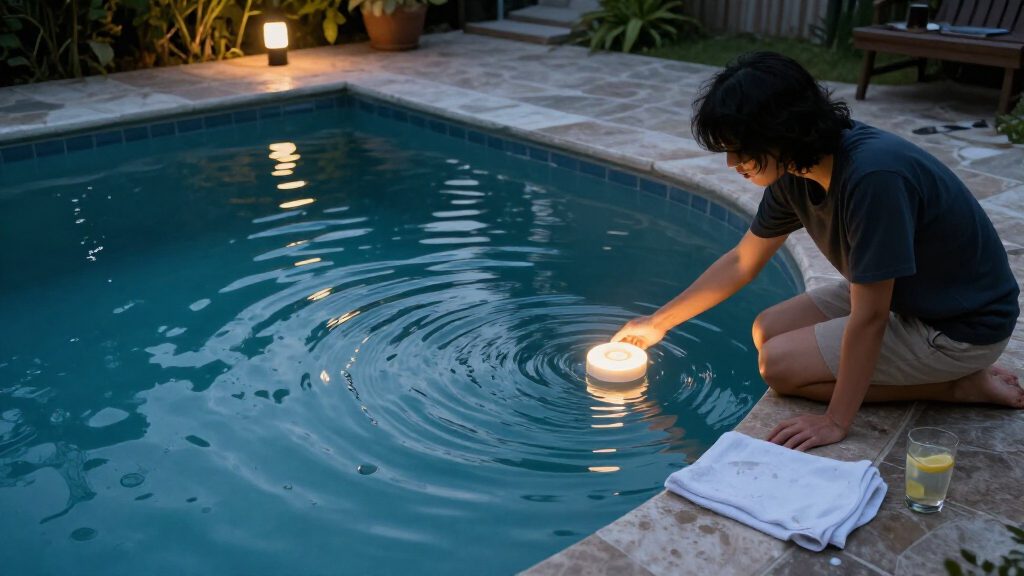
LED floating pool lights are portable, low-voltage lights built to rest on the water or operate while submerged, depending on the model’s rating. They use light-emitting diodes to create steady or changing colors, typically from a battery, rechargeable cell, or solar panel. Unlike a permanently installed pool light, you can lift one out and move it.
That portability gives you options: one glowing orb can mark the edge of a small plunge pool, while several lights can spread color across a larger pool for a gathering. Designs come in various forms, from simple discs to spheres and playful shapes, and are often designed to add to the appeal of pools after dark. A soft white setting can feel calm; fast-changing rainbow modes can make the water look like a party.
There’s a useful distinction: floating lights generally add atmosphere, not dependable illumination for swimming or identifying every step and depth change. For example, if your family swims after dusk, an attractive floating orb should complement suitable pool lighting, not stand in for it. Check the product manual for whether it is intended to float, be submerged, or do both; those uses are not interchangeable.
Think of these lights as the table lamps of a backyard: they change how a space feels, but they don’t replace the lighting and safety features the space needs. Style is the bonus; proper pool lighting and supervision remain separate responsibilities.
As an affiliate, we earn on qualifying purchases.
How to choose a light that fits your pool and routine
LED floating pool lights are easiest to choose when you compare their water-use rating, runtime, charging method, and controls against a real evening at your home. These features work together: a long runtime is of little help if the product is not rated for your pool, and a convenient charging method cannot compensate for controls you find awkward. A rechargeable light may suit weekly swims, while a solar model may be more convenient in a sunny yard where you can leave it out to charge. The cheapest option can still be the wrong fit if it runs out before your guests arrive.
- Check the intended water use. Look for clear manufacturer instructions stating whether the model floats, is submersible, or is suitable for pool use. This determines where and how you can use it—not just how it looks in a product photo. Do not infer a rating from a sealed-looking shell.
- Match runtime to your plans. The supplied guidance gives a typical battery range of 4–12 hours. Compare the stated runtime with the full time you expect the light to be on, not just the time people are swimming. If your gatherings last into the evening, choose a model whose stated runtime covers the whole occasion, with some margin for settings or conditions that may shorten it.
- Pick a charging style. USB charging offers a predictable routine when you can bring the light inside and recharge it between uses, but you need to remember to do so. Solar reduces plug-in charging and can work well when the light receives direct sun; the tradeoff is less predictable charging when it is shaded or the weather is cloudy.
- Choose controls you’ll use. A simple switch is quick for occasional use and means fewer accessories to manage. A remote or app is handy when the light is across the pool, but adds a device or setup to keep track of. Consider whether that convenience solves a recurring problem before paying for it.
- Check the build and care instructions. Look for outdoor-suitable materials, a stated waterproof rating, and guidance for cleaning and storage. Clear instructions matter because even a well-built light can be damaged by unsuitable charging, cleaning, or winter storage.
For example, a household hosting a four-hour birthday swim might favor a rechargeable light with a reliable stated runtime and a straightforward on/off control, rather than paying extra for app features no one will use. Someone decorating a sunny pond may prefer solar and accept that cloudy days mean less predictable brightness. Buy for your normal use, not a feature list.
As an affiliate, we earn on qualifying purchases.
Battery, USB, or solar: compare the trade-offs before you buy
Battery and charging choices shape not only how much effort a floating light takes to use, but also how reliably it will be ready when you want it. USB models offer a familiar routine: bring the light inside, charge it, then return it to the water. This puts charging under your control, provided you remember the routine. Solar models avoid regular plug-in charging, but their performance depends on how much direct sun reaches the panel, so convenience can come at the cost of consistency. Disposable-battery models can be convenient in a pinch, though you’ll need replacements and should account for their ongoing cost and disposal.
| Power option | Works well when | Trade-off |
|---|---|---|
| USB rechargeable | You can charge the light between uses and want predictable preparation. | You need to remember to charge it and follow the maker’s charging instructions. |
| Solar | The light can receive strong daylight and you want less plug-in charging. | Shade, short winter days, or cloudy weather can limit charge and runtime. |
| Replaceable batteries | You want a quick way to restore power without waiting for a recharge. | Replacement batteries add ongoing cost and need responsible disposal. |
The guidance supplied for this article puts typical battery operation at about 4–12 hours per full charge, but that range is not a promise for every product. The difference matters when a light is meant to last through a planned event: a shortfall may leave the pool dark before guests leave. Brightness, color effects, age, and temperature can affect actual runtime, so check the specific manufacturer’s figures. A light set to a vivid flashing mode at a summer party may not last as long as one on a steady, dim setting.
Try a simple test before relying on a new light for an event: charge it fully, run your preferred mode for an evening, and note how long it stays bright. If you use solar, compare a clear day with a cloudy stretch; that helps you judge whether its convenience is worth the variation for your routine. Solar trades charging convenience for weather dependence; USB trades that dependence for a charging routine.
As an affiliate, we earn on qualifying purchases.
Use color effects and smart controls without adding hassle
Color-changing LEDs and remote controls let you adjust the mood without reaching across the pool, and some newer products offer app control, automation, or music-linked effects. A steady warm tone can suit a quiet evening, while slow fades add movement without turning the pool into a flashing light show. The useful question is not how many modes a light offers, but whether you’ll use them—and whether the effect suits the way you use the pool.
Some floating pool lights respond to remotes or smartphone apps, and selected models advertise voice control through smart-home devices. These features can be convenient when you want to switch several lights on from the patio, especially if the lights are spread across a large pool. But app connectivity may rely on a compatible phone, network, or bridge; setup and compatibility can add friction to a product meant to be simple. Read the product requirements rather than assuming a light will connect directly to every home system.
Imagine setting up a small dinner beside the pool. You choose a steady blue setting, then switch to a slow color fade when friends arrive. A remote makes that quick. Music synchronization might suit a lively party, but it can be distracting during a calm swim and may use power faster, depending on the model. That tradeoff is worth considering if runtime matters more to you than a changing display.
Choose the simplest control that solves a real problem. If you’ll be standing poolside, a manual switch may be enough and avoids another device to charge or misplace. If you often place lights across a wide pool or use several at once, remote control can save repeated trips. More features don’t automatically mean a better evening; predictable, easy controls often win.
As an affiliate, we earn on qualifying purchases.
Check safety labels—and keep supervision separate from lighting
A floating pool light is suitable for water only when its manufacturer says it is and provides instructions for that use. Low-voltage operation and a sealed design can reduce electrical risks, but neither makes every light safe to submerge or suitable for every pool. The distinction matters because a light designed to float on the surface may not be built for submersion, and using it beyond its stated purpose can compromise its protection. Check the stated water-use rating, inspect the housing and seals, and stop using a unit that cracks, leaks, or behaves unusually.
IP ratings describe protection against dust and water under specified test conditions; they do not replace the product’s own instructions. Look for clear language covering pool use, submersion depth if relevant, charging, and whether the light must be removed before swimming. These directions explain the conditions under which the product is intended to operate. Never charge a product in or beside the water unless its instructions explicitly allow it. Keep charging cables and power sources away from wet areas.
Here’s the part that matters most for families: a glowing surface can make a pool look inviting, but it does not show that a child is safe. A decorative light may draw attention to the water without clearly showing a swimmer, the pool’s depth, or a hazard. Children need active, close adult supervision around pools, and barriers, alarms, and other appropriate drowning-prevention measures remain important. Assign a responsible adult to watch the water rather than expecting a light to make swimmers visible enough on its own.
Pool lights decorate water; they do not supervise it or prevent drowning. Treat them as an atmosphere upgrade, never as a safety device.
If you’re unsure whether a model is intended for your pool, contact its manufacturer before using it. Product descriptions can be vague, so a specific answer about the rating and intended use is worth more than a photo that makes the light look watertight.
Keep your light bright with a quick care routine
Regular cleaning, sensible storage, and battery checks help a floating light stay useful. Pool water can leave mineral marks, while sunscreen, leaves, and grit collect on the surface. If residue builds up, it can dull the light or make it harder to notice damage around the casing. After use, follow the maker’s care instructions; where permitted, rinse the light with fresh water and wipe it gently with a soft cloth. Avoid harsh cleaners unless the manufacturer approves them.
For a practical routine, inspect the shell and seals before placing the light in water. This gives you a chance to spot damage before water gets inside. After an evening swim, remove leaves and debris, dry the charging connection if the instructions call for it, and recharge or store the unit as directed. If it uses a solar panel, wipe away dust so sunlight can reach the surface; a cloudy panel after a windy day can explain a dimmer-than-usual glow. Care is most useful when it follows the design of the specific product, so don’t assume that rinsing or drying steps are identical for every model.
For instance, if a light that once lasted all evening now fades after an hour, first check whether it received a full charge and whether you changed to a brighter or animated mode. Those are simple causes to rule out before assuming the battery has failed. Look for a loose cover, visible damage, or residue around the charging area. Don’t open a sealed casing to investigate unless the product instructions tell you to; doing so can compromise its water protection.
Care can extend the useful life, but no single lifespan applies to every model. The supplied product information says many may last 3–5 years or more with proper care; treat that as a general estimate, not a guarantee. Follow the maker’s maintenance and storage guidance, especially when you close the pool for the season or face freezing temperatures, since unsuitable storage can damage the casing or battery.
Frequently Asked Questions
Are LED floating pool lights safe to use in a pool?
They can be suitable when the manufacturer explicitly rates the model for your intended pool use and you follow its instructions. Check the water-use rating and inspect the light for damage before use. Decorative lighting does not replace supervision or drowning-prevention measures.
How long do floating pool lights run on a charge?
The supplied product guidance gives a typical range of about 4–12 hours, but runtime varies by model, brightness, effects, battery condition, and other factors. Check the manufacturer’s stated runtime, then test your preferred setting before counting on it for a party.
Are solar floating pool lights a good choice?
Solar models can be convenient where the panel receives plenty of direct sunlight. Shade, cloudy weather, and shorter winter days can reduce charging, so they may be less predictable than a fully charged USB model. They suit users who value fewer plug-in charges more than guaranteed runtime.
Can I use a floating pool light in a pond or fountain?
Some models are suitable for ponds, fountains, or other decorative water features, but check the manufacturer’s instructions first. Confirm that the light is rated for that setting and consider how you’ll retrieve it for cleaning or charging. Pool-use approval does not automatically cover every water feature.
How should I clean and store a floating pool light?
Follow the product manual. If it allows, rinse off pool residue with fresh water, remove debris, and wipe the housing gently; keep solar panels clear and check seals for damage. Store and charge the light as directed, and don’t use a unit with a cracked casing or signs of water intrusion.
Conclusion
Choose a floating pool light for the water it’s rated for, the hours you need it to run, and the charging routine you’ll actually follow. Test it before a gathering, keep it clean, and use its colors to set the mood—not to replace proper pool lighting or active supervision.
A good light turns dark water into a gentle ribbon of color. Let it make the evening memorable, while the safety plan stays firmly on shore.
Halloween Picks
halloween
As an affiliate, we earn on qualifying purchases.