Yes, custom 3D-printed forms and molds are finally more affordable. Advancements in materials like metals and composites, along with improved printer speed and precision, make creating complex shapes easier and cheaper. Small businesses and hobbyists can now access desktop printers and online templates to produce tailored designs without high costs. While challenges remain, ongoing innovations continue to lower barriers, so explore further to discover how affordable custom 3D printing has become for you.
Key Takeaways
- Advances in materials and printer technology now enable cost-effective production of complex, custom 3D-printed forms and molds.
- Reduced need for traditional tooling and molds cuts upfront costs, making small-batch and personalized manufacturing more affordable.
- Desktop 3D printers with affordable filaments like PLA and ABS facilitate accessible custom shape creation for small businesses and hobbyists.
- Faster printing speeds and multi-material capabilities expand design options while decreasing production time and costs.
- Industry trends show ongoing improvements in affordability, quality, and material options, making custom 3D-printed forms increasingly accessible.
The Evolution of 3D Printing Technology and Materials
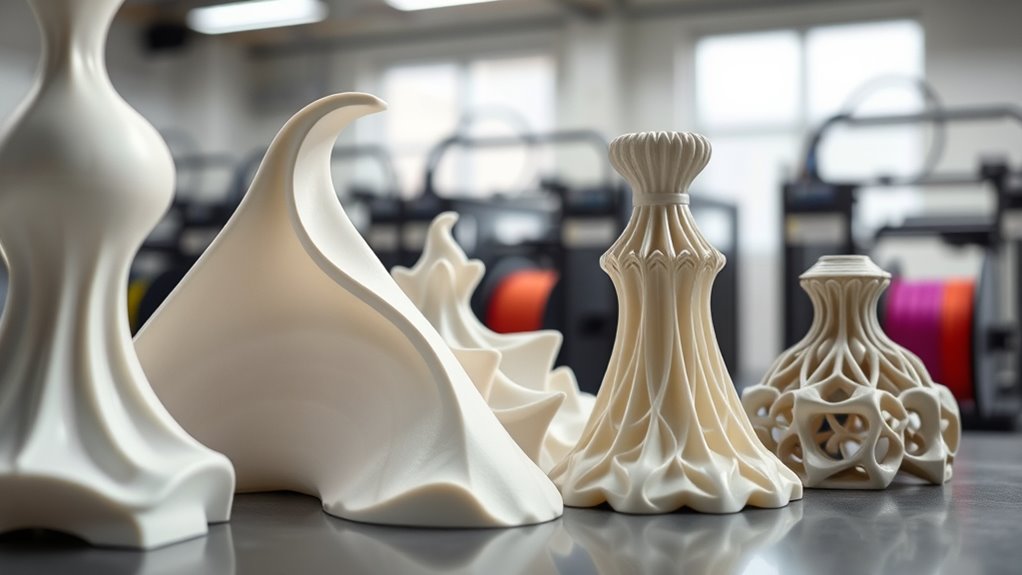
Since its inception, 3D printing technology has rapidly evolved, transforming from a niche prototyping tool into a versatile manufacturing process. You’ve seen how early printers used basic plastics, limiting their applications. Today, advances in materials have expanded options to include metals, ceramics, composites, and bio-inks. These new materials offer increased strength, heat resistance, and flexibility, enabling you to produce complex, durable parts in a single process. Improvements in printer precision and speed have also made 3D printing more practical for larger-scale production. The development of multi-material and hybrid printers now allows you to combine different substances seamlessly, opening new possibilities for customized, functional shapes. Additionally, diverse design options are now achievable, allowing for more creative and personalized outputs. This evolution means you can now create highly sophisticated, tailored forms more efficiently and affordably than ever before.
Cost Factors in Producing Custom Molds and Shapes
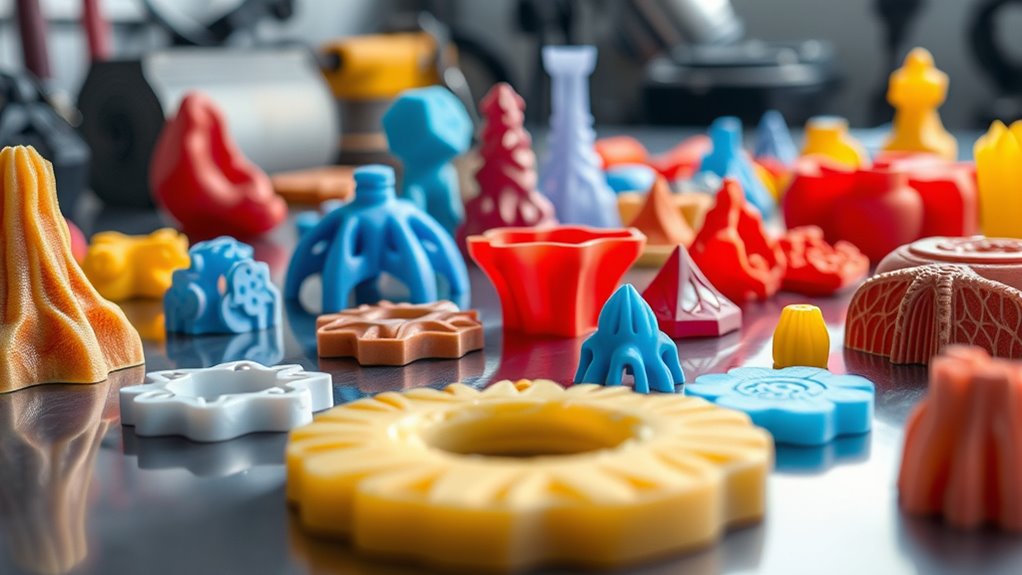
Producing custom molds and shapes with 3D printing involves several key cost factors that can considerably impact your overall expenses. Material costs vary depending on the filament or resin used, with higher-quality options increasing costs. Printer setup, including design time and calibration, also plays a role, especially for complex shapes. Printing speed affects labor and energy expenses, with faster prints often costing more in equipment or material waste. Here’s a visual to picture it:
| Cost Factor | Impact |
|---|---|
| Material | Quality and quantity influence overall expenses |
| Printing Time | Longer prints mean higher energy and labor costs |
| Design & Setup | Complexity increases preparation costs |
Understanding these factors helps you budget better and optimize your 3D printing projects.
Comparing Traditional Manufacturing With 3D Printing Solutions
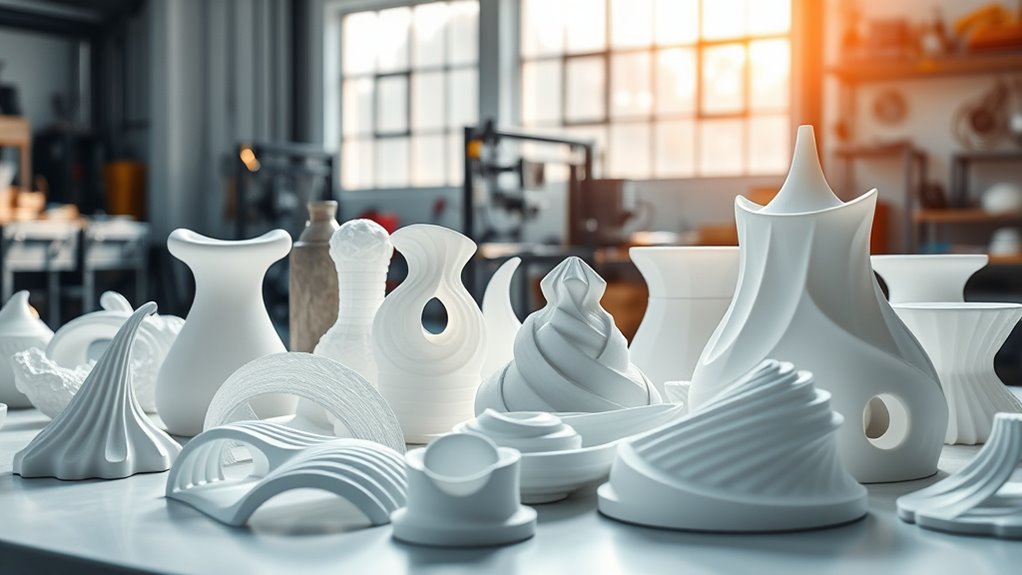
When evaluating manufacturing options, it’s important to contemplate how traditional methods compare to 3D printing regarding cost, speed, and flexibility. Traditional manufacturing often involves expensive molds and tooling, which can be costly and time-consuming to produce. This makes it less ideal for small batches or custom shapes. 3D printing, on the other hand, reduces upfront costs since you don’t need molds and can produce complex geometries directly from digital files. It also offers faster turnaround times, allowing you to iterate designs quickly. Plus, 3D printing provides greater flexibility, enabling you to customize shapes easily without retooling. While traditional methods excel in high-volume production, 3D printing is increasingly advantageous for low-volume, custom, or complex parts, making it a compelling alternative for many applications. High-volume production is where traditional manufacturing still holds a significant advantage due to its efficiency at large scales.
Affordability for Small Businesses and Hobbyists

3D printing offers small businesses and hobbyists a cost-effective way to produce custom forms and molds without breaking the bank. You can easily experiment with designs thanks to its accessible flexibility, saving time and money. This approach makes it simpler to turn ideas into reality without needing expensive equipment or large-scale investments. Additionally, understanding the types of bicycle races can inspire innovative designs for cycling accessories or promotional materials.
Cost-Effective Production Options
For small businesses and hobbyists, cost-effective 3D-printed forms and molds are more accessible than ever, thanks to affordable printers and materials. You can now produce high-quality prototypes and small batches without breaking the bank. Desktop FDM printers, which are budget-friendly, provide reliable results for creating durable molds. Resin printers, while slightly more expensive, deliver finer details necessary for precise forms. Material costs have also decreased, with options like PLA, ABS, and flexible filaments offering versatility at low prices. Additionally, online marketplaces offer pre-designed templates or ready-to-print files, saving you time and money. Overall, these advancements enable you to experiment, iterate, and produce custom shapes efficiently and affordably, making 3D printing a practical solution for small-scale manufacturing and creative projects. Incorporating tuning techniques from automotive modifications demonstrates how tailored adjustments can optimize performance and quality in your 3D-printed forms.
Accessible Design Flexibility
Thanks to affordable 3D printers and user-friendly design tools, small businesses and hobbyists can now create highly customized forms and molds without significant upfront costs. This accessibility opens new creative possibilities and reduces the barriers to innovation. With these tools, you can:
- Quickly iterate designs, saving time and resources.
- Experiment with complex shapes that traditional methods can’t easily produce.
- Tailor molds precisely to your unique specifications, enhancing product quality.
- Incorporate rustic design elements that complement your projects and add authenticity.
This flexibility means you don’t need large budgets or specialized skills to bring your ideas to life. Instead, you can focus on refining your designs, testing prototypes, and scaling your projects affordably. The combination of affordability and design freedom empowers you to compete with bigger players and turn your creative visions into reality.
Limitations and Challenges of 3D-Printed Custom Forms

While 3D-printed custom forms offer remarkable flexibility, they also come with significant limitations. One major challenge is material strength; many 3D printing materials can be less durable than traditional options, limiting their use in high-stress applications. Print resolution and surface finish can also be issues, resulting in rough textures or inaccuracies that require post-processing. Speed can be another obstacle, especially for large or complex shapes, since printing times may be lengthy. Additionally, costs can add up, with high-quality printers and materials demanding significant investment. Compatibility issues may arise, as not all designs translate smoothly from digital models to physical forms. Finally, the technology still faces ongoing development needs to improve reliability, consistency, and scalability for broader industrial adoption. Sound healing science principles are also being explored to enhance material properties and healing effects in innovative ways.
Innovative Applications Transforming Industries
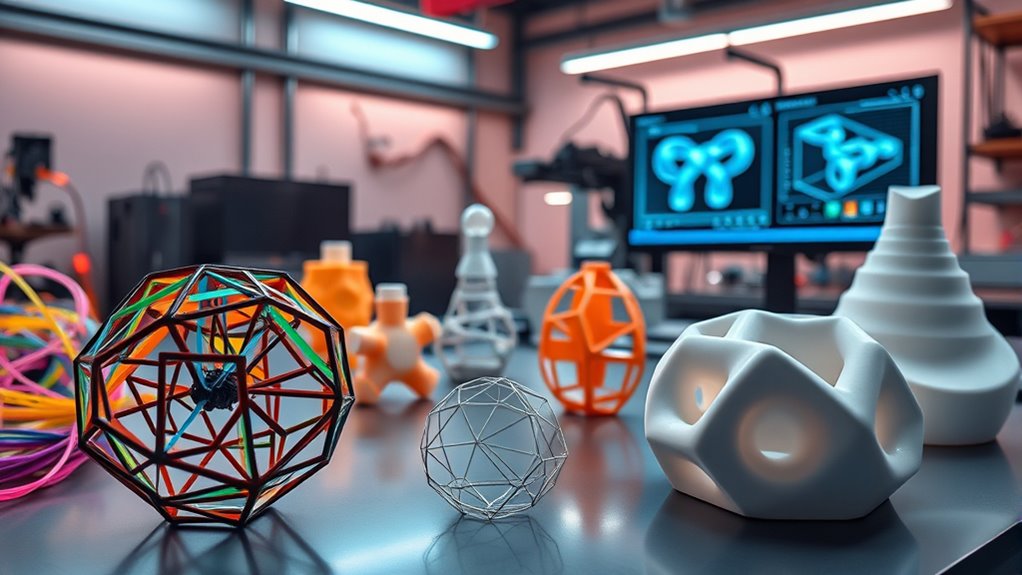
Innovative applications of 3D-printed forms are revolutionizing various industries by enabling rapid prototyping, customized manufacturing, and complex design realization. You can now create prototypes faster, reducing time and costs considerably. Custom parts are more accessible, allowing you to tailor products precisely to customer needs. Additionally, intricate designs that were once impossible or expensive to produce are now achievable, opening new creative possibilities. These advancements are supported by Efficient General Ledger Coding, which helps companies manage the financial aspects of adopting new technologies more effectively.
For example:
- Aerospace companies use 3D printing for lightweight, complex components, improving fuel efficiency.
- Medical fields personalize implants and prosthetics, enhancing patient comfort and outcomes.
- Fashion designers craft unique, detailed accessories and jewelry that stand out in the market.
These innovations are transforming industries, making advanced, tailored solutions more practical and affordable.
Future Trends in Cost-Effective Custom Fabrication
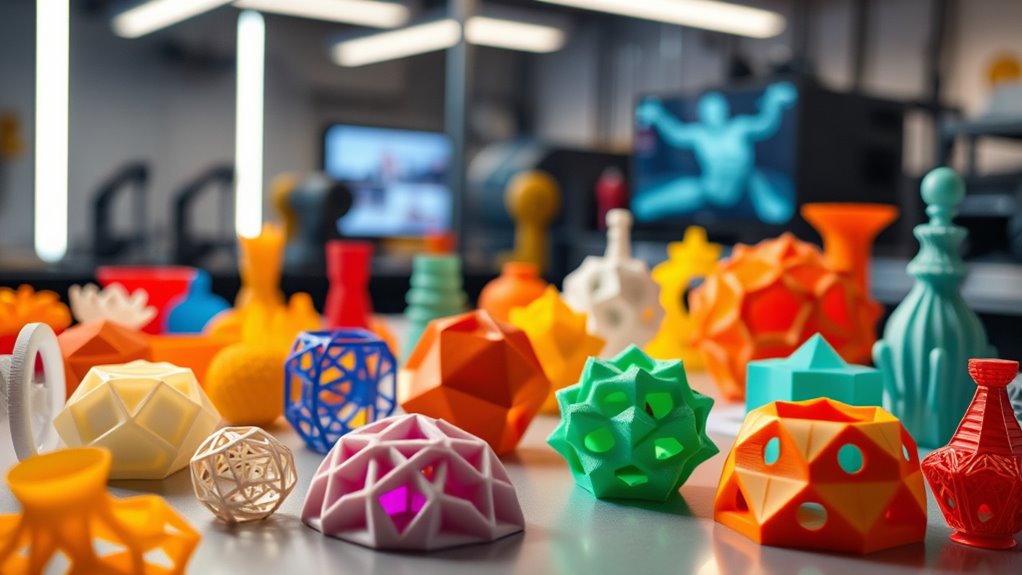
Advancements in 3D printing are making custom fabrication more affordable by cutting production costs and speeding up prototyping. As technology improves, you’ll see greater design flexibility, allowing for more innovative and tailored solutions. These trends are set to reshape how you approach manufacturing and product development. Additionally, sustainable materials are increasingly being integrated into 3D printing processes, further enhancing the environmental benefits of custom fabrication.
Reduced Production Costs
As 3D printing technology becomes more accessible, production costs continue to decline, enabling manufacturers to create custom molds and forms more affordably. This shift impacts your business by reducing upfront investments and shortens development cycles. Consider these benefits:
- Lower material costs — 3D printing minimizes waste, saving money on raw materials.
- Reduced tooling expenses — you no longer need costly, traditional molds for small batches.
- Faster turnaround times — quicker production means you can meet tight deadlines and adapt designs rapidly.
- Enhanced customization options — the ability to produce unique preppy dog names and other personalized shapes becomes more feasible with lower costs.
These factors combine to make custom shapes more financially feasible than ever before, opening new opportunities for innovation and customization without breaking the bank. As costs fall, you gain a competitive edge by producing complex, tailored parts efficiently and affordably.
Rapid Prototyping Growth
With the decreasing costs and faster turnaround times enabled by 3D printing, rapid prototyping is poised to experience significant growth in the coming years. You’ll be able to iterate designs more quickly, reducing the time from concept to functional model. This acceleration allows for more testing, refinement, and innovation without the usual financial barriers. As 3D printing technology becomes more accessible, small businesses and startups can produce prototypes in-house, avoiding costly external services. This shift boosts overall productivity and shortens development cycles. Additionally, the ability to create complex geometries on demand means you can test more intricate ideas without added expense. Rapid prototyping will become a standard part of your workflow, enabling you to bring ideas to life faster and more affordably than ever before.
Design Flexibility Expansion
The future of cost-effective custom fabrication is marked by a significant expansion in design flexibility, driven by the capabilities of advanced 3D printing technologies. You’ll find that complex geometries, intricate internal structures, and customized features are now easily achievable without added costs. This shift allows you to:
- Quickly iterate designs, reducing development time.
- Create personalized products tailored to individual needs.
- Experiment with unique shapes that were previously impossible or too costly.
- The integration of advanced manufacturing techniques further enhances the ability to produce highly complex and functional designs at an affordable scale.
As a result, you can push creative boundaries while maintaining affordability. The increased flexibility means you no longer need to compromise on form or function due to manufacturing constraints. This evolution empowers you to innovate freely, opening new possibilities across various industries.
Frequently Asked Questions
How Durable Are 3d-Printed Molds Compared to Traditional Ones?
3D-printed molds can be quite durable, but they generally don’t match the longevity of traditional molds. You might find that depending on the material used, your 3D-printed mold holds up well for small batches or prototypes, but for high-volume production, traditional molds tend to last longer and withstand more wear. If you prioritize quick, cost-effective production, 3D-printed molds work well, just be aware of their limitations in durability.
What Are the Environmental Impacts of 3d-Printed Custom Forms?
You might find it surprising that 3D-printed forms can markedly reduce waste, cutting material use by up to 50% compared to traditional methods. This minimizes environmental impact by lowering resource consumption and waste. Plus, you can choose eco-friendly filaments like biodegradable plastics, further decreasing your carbon footprint. While energy use for printing is a concern, optimizing print settings and using renewable energy sources make 3D printing a greener alternative overall.
Can 3D Printing Produce Large-Scale or Complex Shapes Efficiently?
Yes, 3D printing can produce large-scale and complex shapes efficiently. You can utilize large-format printers or assemble smaller printed sections seamlessly. This method reduces material waste and enables rapid prototyping of intricate designs. While printing large objects may take more time, advancements in technology have markedly improved speed and precision, making it a practical option for creating detailed, complex structures without the high costs typically associated with traditional manufacturing methods.
What Post-Processing Is Required for 3d-Printed Molds and Forms?
You typically need to clean, remove support structures, and sand the surface of your 3D-printed molds and forms. Sometimes, you’ll apply a sealing or coating to improve durability and prevent leaks or damage during use. If precision is essential, consider additional finishing steps like polishing or surface smoothing. These post-processing steps ensure your molds perform effectively and last longer, giving you the best results with your custom shapes.
Are There Industry-Specific Regulations Affecting 3d-Printed Custom Parts?
Industry-specific regulations can be a maze, but they do impact your project. You might find certain sectors, like aerospace or medical, impose strict standards on materials and processes, acting as gatekeepers. To stay ahead, you’ll need to navigate these rules with precision, ensuring your custom parts meet safety, quality, and compliance requirements. Ignoring them could turn your innovation into a regulatory storm, so stay informed and proactive.
Conclusion
Now, you can embrace the future of manufacturing with affordable, custom 3D-printed forms and molds. You can experiment more freely, innovate faster, and bring your ideas to life without breaking the bank. You can choose traditional methods or explore new possibilities, overcome limitations or push boundaries. Whether you’re a hobbyist or small business, the era of affordable, custom shapes is here—ready for you to create, customize, and revolutionize your projects.