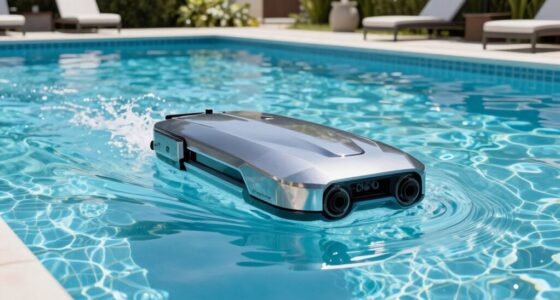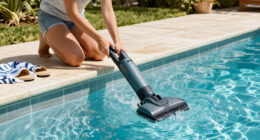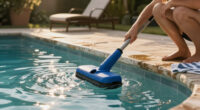
Choosing an automatic pool cleaner is mainly a choice between paying more for a machine that works independently and spending less on a cleaner that relies on the pool equipment you already own. Robotic pool cleaners have their own motor and filter, and many models can scrub the floor and walls on a programmed cycle. Suction-side cleaners connect to a pool’s skimmer or dedicated suction line and use the circulation pump to move and collect debris.

Get pool and patio gear delivered free with Prime
- Fast, free delivery on millions of items
- Prime Video, Amazon Music and more included
- Member-only deals all year

iGarden K Series Cordless Robotic Pool Cleaner
- ✔ Pool type: Inground pools
- ✔ Suction capacity: 22,000 LPH
- ✔ Runtime: Up to 7 hours floor-only; up to 3.75 hours floor, wall, and waterline

Beatbot Sora 10 Cordless Pool Vacuum Robot, 6,800 GPH, Mint Green
- ✔ Pool compatibility: In-ground and above-ground; vinyl, concrete, fiberglass, mosaic tile, and ceramic
- ✔ Runtime: Up to 300 minutes
- ✔ Pool coverage: Up to 3,229 sq. ft. (300 m²)

Dolphin Nautilus CC Plus Robotic Pool Cleaner
- ✔ Pool type: In-ground
- ✔ Maximum pool length: 40 ft
- ✔ Cleaning cycle: 2 hours
That difference affects more than the purchase price. It shapes how long cleaning takes, how much work the pool pump does, what debris the cleaner can handle, and how much attention the owner must give the machine. A robotic cleaner is usually the stronger choice for owners who want separate, scheduled cleaning and reduced dependence on the main filtration system. A suction-side model can make better sense for a smaller budget, a simple pool, and an owner comfortable running the pump during cleaning.
The comparison below focuses on those two common types rather than specific brands. Features vary by model, pool shape, surface, and plumbing, so check compatibility and the manufacturer’s specifications before buying.
At a Glance
| Criteria | Robotic pool cleaners | Suction-side pool cleaners | Winner |
|---|---|---|---|
| Upfront cost | Usually costs more to buy; no dedicated suction line is required. | Usually costs less to buy, though a suitable suction connection and pump setup are needed. | B |
| Cleaning independence | Runs on its own motor and filtration system, separate from the pool pump. | Uses the pool pump, plumbing, and filter; cleaning depends on the circulation system. | A |
| Energy use | Uses electricity while cleaning but can operate without running the main circulation pump for that task. | Requires the pump to run during cleaning, adding operating time and pump wear. | A |
| Debris handling | Collects debris in its own basket or filter; capacity and fine-particle filtration vary. | Sends debris to the pool’s filter or a compatible leaf canister; fine debris and heavy leaf loads can challenge some setups. | Depends |
| Coverage and scrubbing | Many models scrub the floor and walls; navigation and waterline cleaning vary. | Often focuses on the floor; wall coverage and movement depend on design, suction, and pool conditions. | A |
| Installation and compatibility | Generally straightforward to set up, but cable handling, outlet safety, pool shape, and model limits matter. | Must connect to a skimmer or dedicated suction line; hose length, flow, and pool layout affect suitability. | A |
| Maintenance | Requires removing and rinsing its filter or basket, plus care for the cord, tracks, and moving parts. | Requires hose checks and occasional clearing, alongside the usual pool-filter cleaning. | A |
iGarden K Series Cordless Robotic Pool Cleaner
The iGarden K Series is the most configurable cleaner in this lineup. Its four modes let us choose between full coverage, floor-only cleaning, wall and waterline cleaning, or prioritizing the walls and waterline. That flexibility is useful when the pool’s needs vary from one run to the next; compared with the Dolphin’s stated two-hour cycle, we can target a zone instead of treating each session as the same job.Its stated up to 7,233 sq. ft. floor coverage and up to seven hours of floor-only runtime make it the strongest match here for buyers focused on extended floor cleaning. There is a meaningful caveat: runtime falls to up to 3.75 hours in Floor, Wall & Waterline mode. We should choose a mode with that difference in mind rather than assuming the longest runtime applies to full-pool cleaning.The removable 4 L dual-layer basket, app and touchscreen controls, and optional finer filter add useful control over maintenance and operation. The optional 50 μm filter is for Floor Only mode, though, so it does not provide the same fine-filtration option during wall and waterline cleaning. Compared with Sora, iGarden lists greater coverage but a smaller basket and no above-ground compatibility in its supplied pool-type specification. Its best role is therefore a feature-rich inground-pool robot, not the universal choice for every pool or cleaning pattern.
Pros:
- Four modes allow floor-only, wall and waterline, or full-coverage cleaning.
- Floor-only runtime is stated at up to seven hours, with coverage up to 7,233 sq. ft.
- Touchscreen and app controls offer two ways to manage cleaning.
- Removable 4 L dual-layer basket supports routine debris removal.
Cons:
- Combined floor, wall, and waterline runtime is up to 3.75 hours.
- The optional 50 μm fine filter is specified for Floor Only mode.
- The supplied pool type is inground pools, so above-ground compatibility is not established here.
Best for: Owners of inground pools who want multiple cleaning modes, app or onboard controls, and extended floor-only cleaning between charges.
Not ideal for: Buyers who need one long cordless run for combined floor, wall, and waterline cleaning, or who need the fine filter option while cleaning those other zones.
Bottom line: We recommend the iGarden K Series for inground-pool owners who value configurable coverage and long floor-only sessions, provided they account for its shorter full-coverage runtime.
“We recommend the iGarden K Series for inground-pool owners who value configurable coverage and long floor-only sessions, provided they account for its shorter full-coverage runtime.”
Beatbot Sora 10 Cordless Pool Vacuum Robot, 6,800 GPH, Mint Green
The Beatbot Sora 10 stands out for covering an unusual combination of areas: floors, walls, waterlines, and shallow sections down to 12 inches. That shallow-area reach gives it a distinct edge over the iGarden and Dolphin descriptions, which do not specify a comparable shallow-zone capability. It is also listed for in-ground and above-ground pools, making it the clearest fit here for households with a pool type outside the inground-only specifications of the other two.With up to 300 minutes of runtime, stated coverage up to 3,229 sq. ft., and a 5 L debris basket, Sora is built for substantial cordless sessions. The basket is larger than iGarden’s 4 L capacity, which may mean fewer interruptions to empty it when collecting leaves. However, its stated coverage is less than half iGarden’s maximum floor coverage, so buyers of larger pools should compare those figures carefully rather than letting runtime alone decide.App control, ultrasonic obstacle avoidance, and automatic waterline parking add convenience after a run. Its standard 150 μm filter handles routine debris, while the 3 μm option is sold separately. Sora also has a defined saltwater limit of below 5,000 ppm NaCl. Compared with the Dolphin’s fixed two-hour cycle, it offers more zones and cordless freedom; compared with iGarden, it broadens pool compatibility but has a lower stated coverage figure and no supplied mode-by-mode runtime breakdown.
Pros:
- Cleans floors, walls, waterlines, and shallow areas down to 12 inches.
- Supports both in-ground and above-ground pools across several listed surfaces.
- A 5 L debris basket has greater stated capacity than iGarden’s 4 L basket.
- Obstacle avoidance and automatic waterline parking are included.
Cons:
- The optional 3 μm filter is sold separately.
- Listed coverage is up to 3,229 sq. ft., below iGarden’s stated maximum.
- Saltwater use is limited to NaCl below 5,000 ppm.
Best for: Owners who need a cordless cleaner for in-ground or above-ground pools, particularly when the pool includes shallow areas.
Not ideal for: Buyers with very large pools who prioritize the highest stated coverage, or anyone who needs ultra-fine filtration as standard or has saltwater above the specified limit.
Bottom line: We would choose Sora when pool-type flexibility and shallow-area coverage matter more than maximizing the stated coverage per charge.
“We would choose Sora when pool-type flexibility and shallow-area coverage matter more than maximizing the stated coverage per charge.”
Dolphin Nautilus CC Plus Robotic Pool Cleaner
The Dolphin Nautilus CC Plus is the straightforward pick: plug it in, let its two-hour cycle run, then remove and clean the top-load basket. Its active brush scrubs the pool surface while the cleaner climbs walls, so it covers more than the floor without requiring us to choose among multiple modes. For buyers who prefer a predictable cycle over the battery planning of iGarden or Sora, that simplicity is the main reason to consider it.Its limits are also clearer. The supplied specification is for in-ground pools up to 40 feet long, while Sora is listed for both in-ground and above-ground pools and iGarden offers more selectable modes. Dolphin’s description does not give a coverage-area or basket-capacity figure, making it harder to compare directly with those cordless models for large or debris-heavy pools. The filter also requires regular cleaning, so the easy-to-remove design does not eliminate maintenance.We rank it third overall because it is less flexible across pool types and cleaning patterns, not because a two-hour cycle is inherently a drawback. Its plug-and-play operation can be a better fit for an owner who wants a defined run and active brushing rather than app controls, obstacle avoidance, or long battery runtime. Buyers should confirm that their pool falls within the stated size and type before choosing it.
Pros:
- Plug-and-play setup and a defined two-hour cleaning cycle.
- Active brush scrubs pool surfaces as the cleaner climbs walls.
- Top-load basket is easy to remove for debris cleanup.
Cons:
- Specified for in-ground pools up to 40 feet long.
- Filter requires regular cleaning.
- Supplied details do not state coverage area, basket capacity, or app controls.
Best for: In-ground pool owners with pools up to 40 feet who want a simple plug-in cleaner with wall climbing and an easy-access basket.
Not ideal for: Owners of above-ground pools, pools beyond the stated length, or buyers who want cordless operation, app control, or a stated coverage-area comparison.
Bottom line: The Nautilus CC Plus suits in-ground pool owners who value a simple, fixed-cycle routine and can work within its 40-foot pool limit.
“The Nautilus CC Plus suits in-ground pool owners who value a simple, fixed-cycle routine and can work within its 40-foot pool limit.”
As an Amazon Associate we earn from qualifying purchases.
Key Differences
The biggest practical difference is independence. A robotic cleaner brings its own drive and debris collection, so it can clean while the pool’s main pump is off. That can reduce the pump’s cleaning run time and makes the cleaner less dependent on skimmer flow or suction balance. A suction-side cleaner has fewer systems of its own, which helps keep its purchase price down, but it must draw power and suction from the pool equipment. If the pump is off, the cleaner stops.
Cleaning performance depends on the pool and the particular model. Robots commonly offer active brushing, programmed routes, and wall climbing, while suction models commonly travel across the floor using water flow. Neither type guarantees complete coverage in every pool. A complicated shape, steps, slopes, textured surfaces, or heavy debris can change the result. Buyers should match the cleaner to pool size, surface, plumbing, debris load, and the kind of coverage they expect.
Value also depends on ownership habits. A suction model is often a sensible economy choice when the pool pump already runs for long periods and the cleaning needs are modest. A robot costs more at the start, but its separate operation and self-contained filter can be worthwhile for owners who want less dependence on the circulation system. Compare the total setup and running routine, not just the sticker price.
Detailed Comparison
Upfront cost (Suction-side pool cleaners wins — major)
Suction-side cleaners usually win on purchase price, making them an accessible entry point for routine cleaning. The gap is often moderate to major, depending on the models being compared. Robotic cleaners cost more initially, but they include their own motor and debris collection, so the higher price buys a more self-contained system. Check whether the suction option needs extra fittings, a leaf canister, or plumbing work; those additions can narrow the difference.
Cleaning independence (Robotic pool cleaners wins — major)
Robotic cleaners win clearly because they operate independently of the pool’s main pump and filter. The difference is major for owners who want to run the cleaner outside normal filtration hours or avoid adjusting suction valves. A suction-side model must be connected to the circulation system and needs the pump running, tying cleaning to the pool’s plumbing and schedule.
Energy use (Robotic pool cleaners wins — moderate)
Robots usually have the advantage when the alternative requires running a large pool pump solely to power a cleaner. Their own motor uses electricity, but the pump may be switched off during the cleaning cycle if filtration needs are otherwise met. The gap is moderate and depends on local electricity rates, pump efficiency, cleaning frequency, and whether the pump would be running anyway. If the pump already runs for filtration during the same period, a suction cleaner’s added energy cost may be small.
Debris handling (moderate difference)
This depends on what lands in the pool and how each system is equipped. Robots collect debris in a removable filter or basket, which keeps the load out of the pool’s main filter; capacity and fine-particle capture differ by model. Suction cleaners send debris through the plumbing to the pool filter, unless a compatible leaf canister intercepts larger material. For frequent leaves, verify basket capacity and clog resistance; for fine dust, compare filtration specifications rather than assuming one type always performs better.
Coverage and scrubbing (Robotic pool cleaners wins — moderate)
Robotic cleaners are generally ahead because many models actively brush surfaces and are designed to climb walls, with some also cleaning the waterline. The practical gap is moderate to major if wall and tile cleaning matter. Suction models often concentrate on the floor, though some designs climb walls under suitable conditions. A robot still may miss steps, corners, or unusual contours, so consult coverage claims for the exact pool and model.
Installation and compatibility (Robotic pool cleaners wins — moderate)
Robots usually have the simpler connection: place the unit in the pool and connect its power supply as directed. The difference is moderate, because safe outdoor electrical placement and cord management still matter. A suction cleaner must match the pool’s skimmer or suction line, hose reach, and available pump flow. It can be easy to set up when those parts are compatible, but plumbing limitations may rule it out or require adjustments.
Maintenance (Robotic pool cleaners wins — minor)
Robots take the edge for keeping collected debris separate from the pool filter, but their own basket or cartridge must be emptied and rinsed. Suction models have fewer powered parts, yet their hoses can leak, twist, or clog, and collected debris reaches the pool filtration system. The difference is minor to moderate: each needs regular attention, just in different places. Choose based on which routine is easier for you, and check the availability and cost of replacement parts.
Robotic pool cleaners: Pros and Cons
Pros:
- Cleans without requiring the main pool pump to run for the cleaning cycle.
- Collects debris in its own removable filter or basket.
- Many models scrub floors and walls, and some clean the waterline.
- Avoids dependence on a skimmer connection or dedicated suction line.
Cons:
- Usually costs more upfront than a suction-side cleaner.
- The filter or basket must be emptied and rinsed.
- Cord handling and model-specific coverage can limit convenience.
- Electrical setup must follow the manufacturer’s safety instructions.
Suction-side pool cleaners: Pros and Cons
Pros:
- Usually has a lower purchase price.
- Has fewer powered components than a robotic cleaner.
- Can work well for straightforward floor-cleaning needs.
- May suit pools whose pump already runs during the cleaning period.
Cons:
- Needs the circulation pump running while it cleans.
- Relies on compatible suction plumbing, flow, and hose reach.
- Debris adds to the load on the pool filter unless intercepted.
- Wall and waterline coverage may be limited or inconsistent.
Who Should Choose What
Choose Robotic pool cleaners if:
- You want cleaning to run separately from the pool’s filtration schedule.
- Your pool has walls or surfaces that benefit from active brushing.
- You prefer debris collected in a removable unit filter instead of sent through the pool plumbing.
- You are willing to pay more upfront for greater independence and broader features.
Choose Suction-side pool cleaners if:
- Keeping the initial purchase price low is your priority.
- Your pool has compatible suction plumbing and a simple layout.
- You mainly need floor cleaning and are satisfied with the coverage your selected model provides.
- The pump already runs during cleaning hours and you are comfortable maintaining the pool filter.
Skip both if: Neither is a good match if your pool’s shape, surface, debris load, or plumbing falls outside the models’ specifications. Compare pressure-side cleaners or manual cleaning for pools that need a different setup.
Value for Money
Paying more for a robotic cleaner is worth it for owners who value independence from the pool pump, self-contained debris collection, and broad surface scrubbing. Those benefits matter most when cleaning would otherwise add pump run time or when the pool needs more than basic floor pickup. The higher purchase price is harder to justify if the pool is small and simple, cleaning demands are light, and the pump already runs for filtration during the same hours.
A suction-side cleaner is generally better value for buyers with compatible plumbing who want a lower-cost way to automate routine floor cleaning. Its low price does not make it cheaper to operate in every situation: pump electricity, added pump hours, filter load, and any required accessories count too. Before buying, compare the model price plus setup costs and expected cleaning routine. Choose the robot when its extra independence and coverage address a real need; choose suction when the savings matter more and its limits fit your pool.
Final Verdict
For most owners who want the cleaner to handle more of the work independently, a robotic pool cleaner is the stronger choice. It does not rely on the circulation pump, keeps collected debris in its own filter, and many models scrub walls as well as floors. Its higher upfront cost makes sense when those features reduce pump dependence or match a pool that needs broader coverage.
Choose a suction-side cleaner if you want the least expensive route to automatic floor cleaning, your pool has compatible plumbing, and the pump will already run during cleaning. The deciding factor is whether you value a lower purchase price more than independent operation. If the budget is tight and the pool is straightforward, choose suction. Otherwise, pay more for the robot when its separate operation and cleaning coverage will be used.
Frequently Asked Questions
Are robotic pool cleaners better than suction-side cleaners?
Robotic cleaners are usually better for independent operation and broad scrubbing, while suction-side cleaners are usually cheaper to buy. The better choice depends on your pool’s needs, compatibility, and budget.
Does a suction-side pool cleaner use more electricity?
It requires the pool pump to run while it cleans. A robot also uses electricity, but it can clean without the circulation pump running for that task. Actual costs depend on pump efficiency, cleaning time, local rates, and whether filtration would already be running.
Can a suction-side cleaner clean pool walls?
Some models can climb walls under suitable conditions, but wall coverage varies with the cleaner design, suction flow, pool surface, and shape. Check the specific model’s coverage claims if walls or the waterline are a priority.
Which type is better for leaves?
Neither type is universally better. Compare the robotic model’s basket capacity with the suction setup’s filter and any compatible leaf canister. Pools with heavy leaf fall need a cleaner that can handle the expected debris without frequent clogging or emptying.
Black Friday Picks

Philips Hue Play Gradient Light Tube, Large, Black
As an affiliate, we earn on qualifying purchases.