To calculate your pool’s volume, start by identifying its shape—rectangular, circular, or irregular—and use the appropriate formulas: length x width x average depth for rectangular pools or π x radius squared x average depth for circular ones. For irregular pools, divide them into sections, calculate each, then add them up. To find the surface area, multiply length by width for rectangular pools or use 2πr x height for cylindrical ones. Keep going to learn more useful tips.
Key Takeaways
- Determine the pool’s shape (rectangular, circular, or irregular) to select the appropriate calculation method.
- Calculate volume by multiplying length, width, and average depth for rectangular pools or using πr²h for circular pools.
- Break irregular pools into geometric sections, calculate each, then sum for total volume, converting cubic feet to gallons (multiply by 7.48).
- Find surface area by multiplying length and width for rectangular pools or 2πr times height for cylindrical pools.
- Use these measurements to ensure accurate chemical dosing, water safety, and maintenance planning.
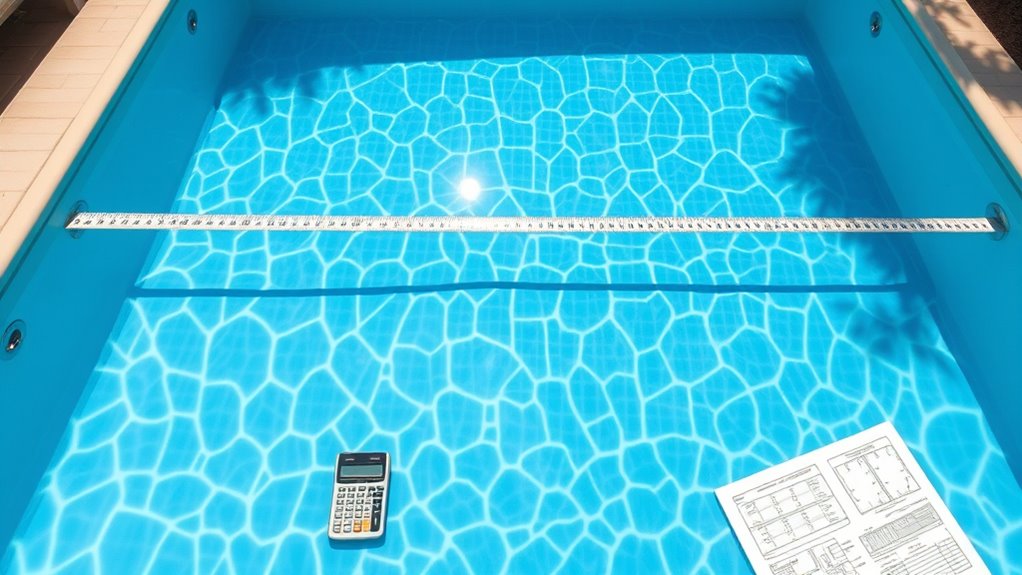
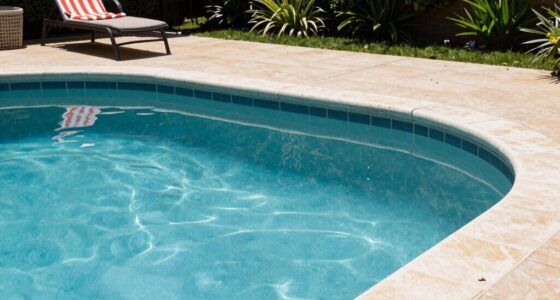
Whether you’re planning a new pool or maintaining an existing one, knowing how to accurately calculate its volume and surface area is essential. These measurements are critical for proper chemical treatment, ensuring your pool stays clean, clear, and safe to swim in. When you understand your pool’s size, you can determine the exact amount of chemicals needed, avoiding over- or under-treatment, which can lead to safety concerns or inefficient use of supplies. Accurate calculations also help you maintain the right pH levels and disinfectant concentrations, which are crucial for safety considerations and preventing bacterial growth. Understanding your pool’s hydraulics can further optimize circulation and filtration, enhancing overall water quality. To find your pool’s volume, start by identifying its shape because formulas vary accordingly. For rectangular or square pools, multiply length, width, and average depth (or height). For example, if your pool measures 20 feet long, 10 feet wide, and has an average depth of 5 feet, the volume is 20 x 10 x 5, totaling 1,000 cubic feet. For circular pools, use the formula π times the radius squared times the average depth. If your pool has a radius of 5 feet and an average depth of 4 feet, the volume would be approximately 3.14 x 5² x 4, which equals about 314 cubic feet. For irregular or freeform pools, break down the shape into manageable geometric sections, calculate each volume separately, and sum them for a total. Converting cubic feet to gallons helps because most chemical treatments are measured in gallons. Since one cubic foot equals approximately 7.48 gallons, multiply your total cubic feet by 7.48. Continuing with the previous rectangular pool example, 1,000 cubic feet equals roughly 7,480 gallons. This precise volume allows you to accurately dose chlorine, algaecides, and pH adjusters, enhancing safety considerations by preventing chemical imbalances that could harm swimmers or damage the pool. Surface area calculations are equally important, especially for chemical treatment and safety considerations. To compute it, multiply the length by the width for rectangular pools or 2πr times the height for cylindrical pools. Knowing the surface area helps determine the amount of surface sanitizer needed and assess evaporation rates, which impact chemical dosing and water safety. Additionally, understanding the surface area can guide safety measures such as installing adequate fencing or slip-resistant surfaces around the pool.

Pool and Spa Volume – Calculator
- Pool volume calculator: Calculate pool volume easily
- Spa volume calculator: Determine spa capacity accurately
As an affiliate, we earn on qualifying purchases.
As an affiliate, we earn on qualifying purchases.
Frequently Asked Questions
How Often Should I Measure My Pool’s Dimensions for Accuracy?
You should measure your pool’s dimensions at least once a season to guarantee measurement accuracy for proper maintenance. Regular measurements help you catch any shifts or changes caused by weather, settling, or usage. Accurate measurements are essential for effective pool maintenance, like balancing chemicals and calculating volume. Keep a record of your measurements, and check more frequently if you notice unusual changes or after major weather events to maintain precise data.
Can Shape Variations Affect the Volume Calculation?
Shape variations definitely influence your volume estimation. While a simple rectangular pool makes calculations straightforward, irregular or curved shapes can lead to inaccuracies if you depend solely on basic formulas. You should measure your pool’s shape carefully and consider more complex calculations or tools for irregular designs. Recognizing how different pool shapes affect volume helps ensure your estimates are accurate, especially when planning chemical levels or filtration needs.
What Tools Are Best for Measuring Irregular Pool Surfaces?
For measuring irregular pool surfaces, you need precise measurement tools that handle surface irregularities. Use a flexible measuring tape or a laser distance meter to navigate uneven edges and contours accurately. A digital water level can also help assess surface slopes. These measurement tools guarantee you capture all surface irregularities, allowing for more accurate volume and surface area calculations, especially when pools aren’t perfectly shaped.
How Do Temperature Changes Impact Water Volume Calculations?
Temperature changes cause water to expand or contract due to temperature expansion, affecting volume calculations. When it gets warmer, water density decreases slightly, leading to a larger volume; cooler temperatures cause contraction. To guarantee accurate measurements, you should account for these temperature effects, especially if your pool’s temperature fluctuates considerably. Monitoring water temperature helps you adjust your volume calculations correctly, maintaining precise data for your pool management.
Is There a Difference Between Fresh and Saltwater Pool Calculations?
Yes, there’s a difference between fresh and saltwater pool calculations. Saltwater pools often have slightly higher salinity, which can affect water chemistry and impact maintenance routines. You’ll need to consider the salinity level when balancing chemicals and managing evaporation or water loss. This ensures your pool stays safe, clean, and properly maintained, preventing issues like corrosion or scaling that can stem from incorrect calculations.

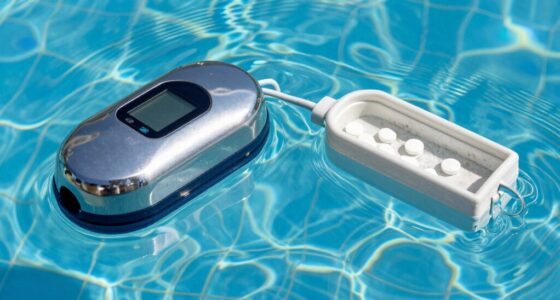
U.S. Pool Supply Scoop Pool Thermometer with Jumbo Easy to Read Temperature
- Submersible and scoop design: Versatile for swimming pools
- Dual temperature units: Fahrenheit and Celsius
- Large display: Easy-to-read temperature readings
As an affiliate, we earn on qualifying purchases.
As an affiliate, we earn on qualifying purchases.
Conclusion
Now that you know how to measure your pool’s volume and surface area, you’re like a captain charting a course through clear waters. With these numbers in hand, you can confidently tackle your maintenance or upgrade plans, turning your backyard oasis into a shimmering jewel. Remember, every calculation is a stepping stone toward perfect clarity and pristine waters. Plunge into your project with excitement — your perfect pool paradise is just a few measurements away!

foriy 3'x16'5'' Drainage Floor Mat Non Slip Commercial Kitchen Mats Pool Mat Bathroom Floor Mat 1/5'' Thick PVC Mesh Hollow Mat for Wet Area Swimming Pool Bathroom Washroom (Grey, 3'x16'5'')
- Material: PVC for durability and flexibility
- Design: S-shaped hollow for easy drainage
- Cleaning: Simple rinse for maintenance
As an affiliate, we earn on qualifying purchases.
As an affiliate, we earn on qualifying purchases.

Freetime Fun Custom Pool Safety Covers for Inground Pool. Oval, Grecian, Kidney, Lazy L, Any Shape or Freeform, Custom Safety Pool Cover Measuring Kit – Fill Out Form | Place Order | Install Cover
- DIY measuring kit: Easy to measure any pool shape
- Domestic manufacturing: Strong mesh or solid fabric covers
- Custom shape compatibility: Any pool shape covered with expert support
As an affiliate, we earn on qualifying purchases.
As an affiliate, we earn on qualifying purchases.